














Traditional Crafts in Aichi
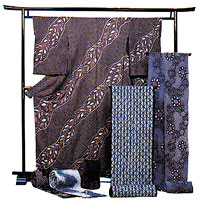
Arimatsu Narumi Shibori
September 4, 1975
Major productsKimono fabrics, yukata (informal cotton kimono), interior products, etc.
Local associationAichi Shibori Industry Association
Telephone: 052-621-1797
Facsimile: 052-621-1244
History of manufacturing districts
The origins of Arimatsu Narumi Shibori date back to the Keicho era in the Edo period (1596-1615) when Takeda Shokuro used the sophisticated tie-dyeing technique called shibori (which was handed down from people involved in the construction of Nagoya Castle), manufactured washcloths (called mame-shibori) and marketed them as kukuri-shibori.
Features of the products
The kukuri (tying) technique has as many as 100 variations (such as kumo-shibori, arashi-shibori and sekka-shibori), and produces a texture which can only be achieved with a handicraft. This technique is used to make furisode (long-sleeved kimono), homongi (semi-ceremonial kimono) and other silk fabrics, cotton yukata and yard goods, as well as interior products.
Manufacturing method
A paper stencil is cut based on a pattern, and the pattern is stenciled onto a piece of cloth using an extract of dayflowers. The cloth is tied with a cotton thread and dyed. The tied areas are not dyed, thus creating a pattern when the thread is removed. The cloth is steamed and ironed out in the final process. The tie-dyeing process takes 50-60 days on average (involving different craftsmen in different processes).
